 Sofia, 105 Kliment Ohridski Blvd.



 Book appointment
EVERYTHING IN THE BODY IS CONNECTED.
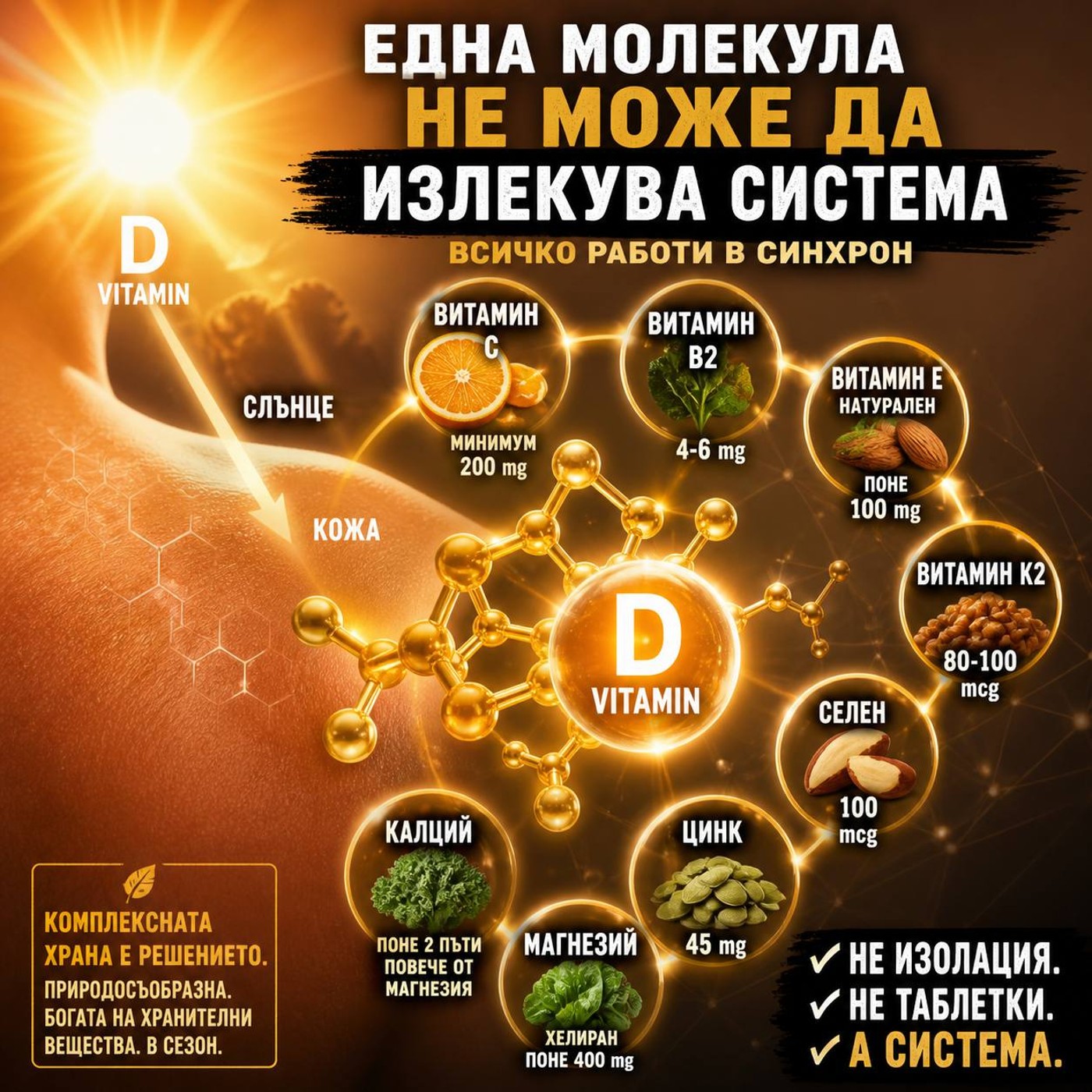
EVERYTHING IN THE BODY IS CONNECTED.
NOTHING WORKS ALONE. There are no "stand-alone" nutrients in the body.
There is a network. Each feature is the result of an interaction:
– vitamins
– minerals
– enzymes
– cofactors
– cellular environment 👉 Example: For vitamin D to work, you don't just have to take it. They are needed:
– vitamin C (~200 mg)
– vitamin B2 (4–6 mg)
– vitamin E (natural, ≥100 mg)
– vitamin K2 (80–100 mcg)
– selenium (~100 mcg)
– zinc (~45 mg)
– magnesium (~400 mg)
- calcium (2:1 to Mg) This is not an "add-on".
It's a system. And one more important thing: 👉 Vitamin C is not just ascorbic acid. It is a complex:
– bioflavonoids
– copper ions
– enzymes (such as tyrosinase)
– trace elements (Fe, Zn, Se, Mn, Mg, P)
– ascorbates and cofactors I.e. what we call a "vitamin" in nature is a network of substances, not a single molecule. 👉 Conclusion:
Isolated components out of context have limited effect.
Sometimes - almost none. THE SOLUTION IS NOT IN THE PILL.
A IN COMPLEX FOOD. If the body works as a system,
there is no way to "fix" it with isolated elements. 👉 Nature does not create single molecules.
Creates entire complexes. Real food contains:
– nutrient synergy
– enzymes
– co-factors
– structures that aid absorption 👉 This is the reason:
one pepper ≠ vitamin C tablet
one yolk ≠ vitamin D capsule In the food you have:
– balance
– proportions
– biological logic 👉 And supplements are often:
– isolated
– devoid of cofactors
- dependent on the body's resource to "finish" them ⸻ 👉 Conclusion: The body does not think in milligrams.
It thinks in interactions. And that's why:
– seasonal food
– local products
– minimal processing
– variety are not a "modern trend"
a biological necessity
 +359 879 570 628
 info@agaia.pro
Comments 0
Share your experience or ask a question — approved comments appear here.
Leave a comment
Comments are published after a short review.